
By Siyasa Jimmy
Children have often been left behind in most facets of social life. Is that because they are mostly ‘small creatures’, hard to notice among the towering adults? Perhaps not; rather, it could be that their existence deceptively looks negligible since they don’t have much to offer in the grand scheme of societal productivity.
Sadly, this reality extends beyond secular life and creeps into the Church.
It is worse in the modern-day church, which is busier than ever, pursuing the Great Commission (Matthew 28: 19-20), extending the kingdom of God on earth, in a capitalist world where adults are the central players. They are the primary givers towards the church’s material needs, including money, human resources and other forms of service.
In this equation, the role of children within the life of the church is unceremoniously relegated, why not? Aren’t they but mere passive participants with little to offer? Why invest as much in their ministry?
Ironically, this reality diametrically opposes Jesus’s stance and commitment to children– “Let the children come to me” (Matthew 19:14), calling for the teaching of the gospel to children and granting them open access into the commonwealth of prospective inheritors of the kingdom of God. In so doing, Jesus was challenging social barriers for children to participate in the life of the church– again, because society at the time viewed children as having low social status and little/no power.
In a new study published in June 2026, Rev. Dr Alex Kamoga, a theologian from Uganda Christian University (UCU), makes a case for why children’s ministry needs more attention and investment than it is currently receiving within the Province of the Church of Uganda. Dr Kamoga and Prof. Dr J.W. Beukes (University of South Africa) argue that “while significant investments are made in adult facilities, children’s spaces are often inadequate.”
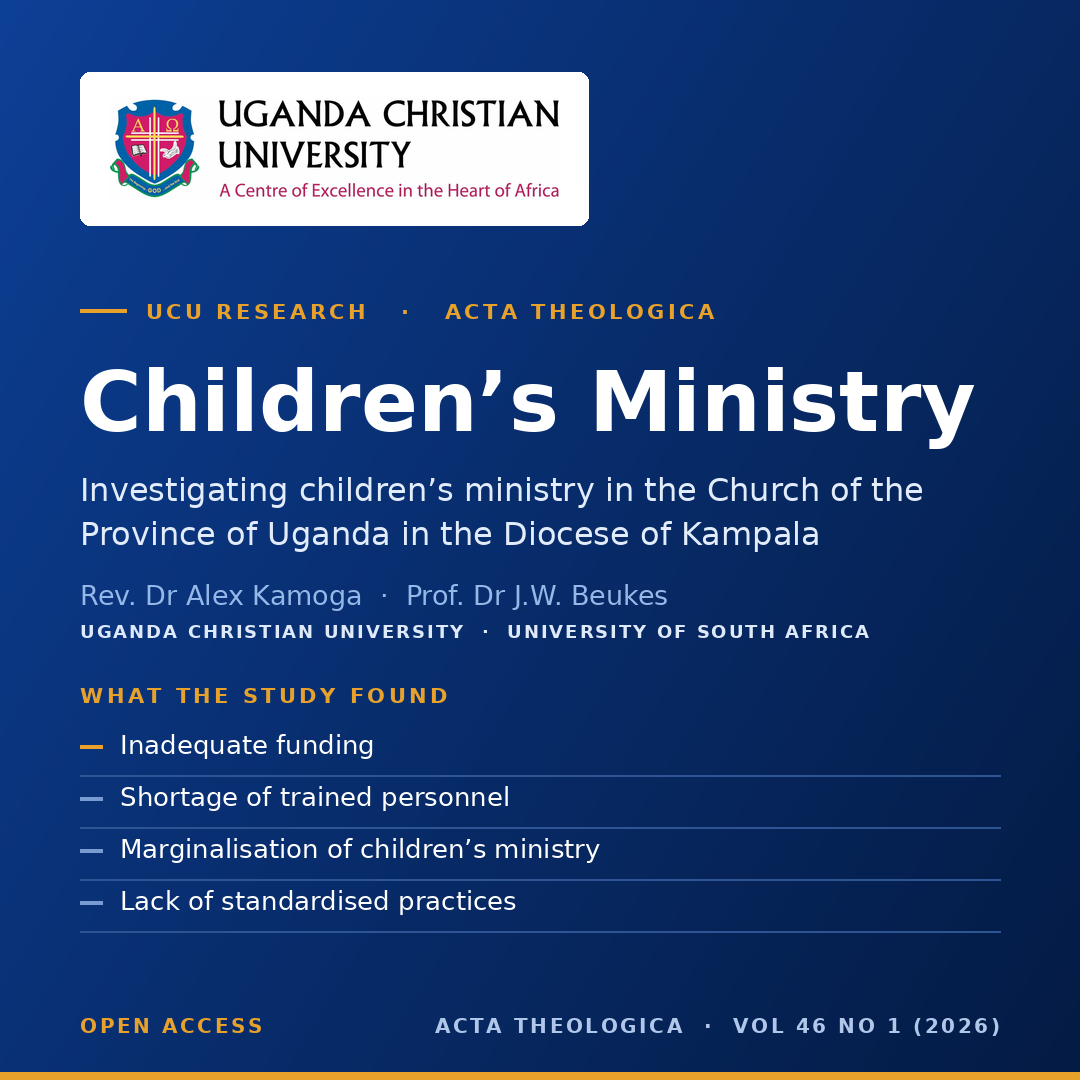
The research paper, titled “Investigating children’s ministry in the Province of the Church of Uganda in the Diocese of Kampala”, paints this crisis with four strokes:
- Inadequate funding
- Shortage of trained personnel: both clergy and volunteers often lack formal training for effective spiritual nurture.
- Marginalisation of children’s ministry
- Lack of standardised ministry practices
The authors argue that these limitations “hinder the church’s capacity to provide holistic spiritual formation for children.”
Through document analysis and in-depth interviews with no less than 25 key stakeholders, the researchers not only diagnosed these maladies but also drew up remedies, thus:
- Intentional investment in children’s ministry: through intentional discipleship, financial investment in resources like children’s Bibles, and payment of children’s ministry facilitators.
- Structured training for children’s ministry workers: achieved through “incorporation of children’s theology into the education of clergy and lay leaders to stress their inherent value in the kingdom of God, the structured and age-oriented training of teachers and leaders and the intensified diocesan backing through financing, training, and resource centres.”
- Standardisation of children’s ministry and strategic prioritisation to enhance effectiveness and sustainability: these include, but are not limited to, coherent curricula, child-friendly environments, and active engagement of children. Additionally, “take ministry beyond church walls through community outreach, school collaborations, and cultural activities.”
This study is an urgent call for all church leaders and stakeholders to course correct their approach to children’s ministry if the contemporary Church of Christ is to flourish holistically.
Read the full article here: https://journals.ufs.ac.za/index.php/at/article/view/10889/5824
Rev. Dr Kamoga is the Chaplain of Makerere University Business School (MUBS) and a part-time lecturer at the UCU Bishop Tucker School of Divinity and Theology.
Prof. Dr J.W. Beukes is Professor in the Department of Christian Spirituality, Church History and Missiology, University of South Africa (UNISA), Pretoria, South Africa.