
By Siyasa Jimmy
A Uganda Christian University (UCU)-led study has established six core factors that increase staff commitment and intention to stay in an organization.
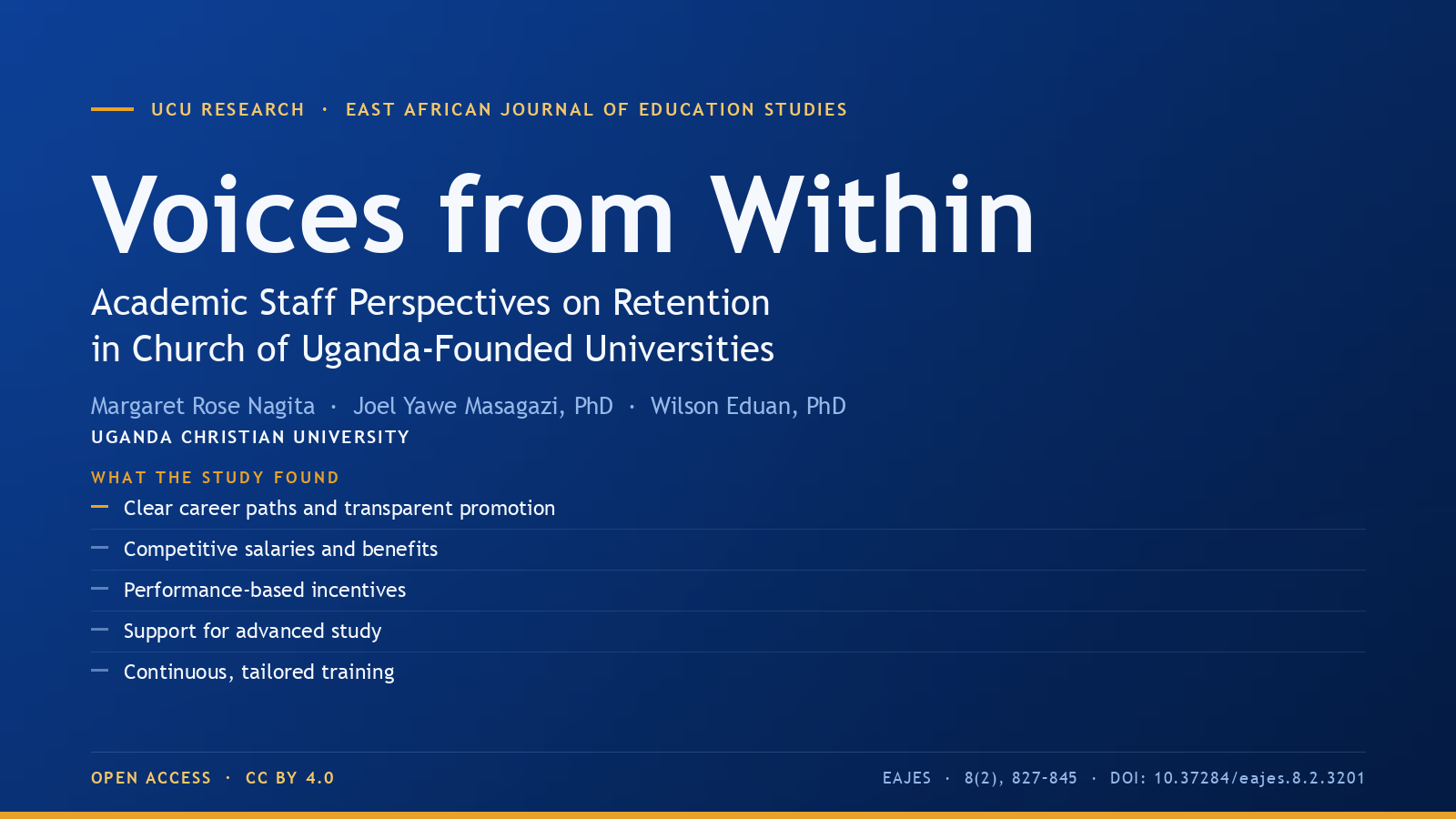
The study titled Voices from Within: Academic Staff Perspectives on Retention in Church of Uganda-Founded Universities focused on two Church-founded Universities.
It names the following as key factors that enhance staff commitment and intention to stay in a university, although are equally applicable to corporations and other organizational settings:
- Transparent Workload Systems: For academic staff, balancing time allocated for teaching and research time proved attractive, desirable and fair for the academic staff interviewed during the study, especially those with other professional responsibilities such as managerial/administrative roles. Additionally, the availability of resources to support research and teaching roles and expectations constituted what some staff term as “fair” workload management.
- Equitable Access to Flexibility: This majorly highlights facilitation of “work-life balance. Besides their academic commitment to the university, are staff able to explore “personal growth outside of work”? One of the participants said “This concern for our personal lives makes the institution a more attractive place to work long term.”
- Clear Career Pathways: Mainly dealing with “upward mobility,” the existence for clear roadmap that shows how staff can move from one role to another, build new skills and develop professionally with the university/ organization. Vague or unclear career pathways proved demotivating to most staff.
- Credible Recognition and Promotion Prospects: Give credit where credit is due. Recognition in this case must go beyond mere professional platitudes or generic tokens; it constitutes legitimate, verifiable, thoughtful and meaningful commendation for excellent work done. Recognition and promotion prospects emerged as a powerful retention driver because they shaped how academic staff interpreted value, fairness, and future belonging within Church of Uganda–founded universities.”
- Promotion Mechanisms: Opportunities for career progression surfaced as a retention anchor through which academic staff interpreted whether their universities offered not only employment, but a credible academic future.
- Supportive Collegial Cultures: Informal, person-to-person support, mentorship, advice, and solidarity among colleagues. Additionally, this included institutional culture and structures, the degree to which the university’s values, administrative support, and participatory practices that enable a supportive environment.
This study led by Dr. Margaret Nagita Kiwanuka, a quality Assurance expert, interviewed up to 48 participants from two, private higher education institutions in Uganda concluded that effective retention in church-founded universities requires “intentional alignment between faith-based values, institutional policies, and lived staff experiences.”
That the participants were professors and lecturers from leading institutions, makes the finds of this study an urgent call and eye opener for, not just higher education top administrators, but specifically Human Resource experts at universities and other non-academic institutions.
Recommendations from the study
Church-founded universities should develop clear and consistently applied workload policies that equitably account for teaching, research, administrative, and pastoral duties across all academic ranks.
Universities should formalise mentorship and career progression systems tailored to different academic stages, from Teaching Assistants to Senior Lecturers.
Recognition and promotion processes should be guided by clearly communicated criteria and inclusive, peer-informed evaluation mechanisms. Involving academic staff in the design and review of these systems promotes procedural fairness and trust. Transparent recognition practices increase job satisfaction and retention.
Faith-based universities should align their Christian ethos with inclusive governance by actively involving academic staff in decisionmaking processes. Collegial support and ethical leadership should be intentionally reinforced through institutional practices. Such environments foster belonging, reciprocity, and sustained academic commitment.
The full study is accessible here: https://journals.eanso.org/index.php/eajes/article/view/3201
The other researchers are Dr. Joel Yawe Masagazi, PhD (UCU) and Dr. Wilson Eduan, PhD; both scholars from Uganda Christian University School of Education.

UCU researchers develop three new nakati varieties
Renowned for its research excellence, the Uganda Christian University (UCU) Faculty of Agricultural

UCU Celebrates 26th Guild Government Swearing-In
Home Students Research Academics About Us Contact Us X UCU student narrates journey

UCU engaged in phase 2 of Uganda’s yellow fever vaccination campaign
UCU engaged in phase 2 of Uganda’s yellow fever vaccination campaign By Irene

“Make Generosity a LifeStyle,” UCU Community Urged.
“Make Generosity a LifeStyle,” UCU Community Urged Uganda Christian University (UCU), in partnership