
Uganda Christian University’s (UCU) Department of Computing and Technology was a hive of activity as students presented their end-of-semester projects, an exhibition of youthful creativity at a time when the country continues to grapple with widening digital gaps.
Only 29 percent of Ugandan households have access to any form of digital technology, according to the Uganda Bureau of Statistics.
Key sectors such as agriculture, health, and urban management continue to lose billions of shillings each year to inefficiencies rooted in outdated systems. It is within this landscape that the students stepped forward, eager to prove that homegrown innovation can offer credible, scalable solutions.
During the session, the head of department, Dr Innocent Ndibatya, reminded the presenters that innovation is as much about discipline as it is about creativity. “Meaningful innovation demands commitment, teamwork, and accountability,” he told them, stressing that each project member ought to fully understand and defend the work produced.
The department, he added, “intends to submit at least five of the best projects to the National Council for Higher Education.”
Among the most striking demonstrations was a sensor-controlled smart irrigation system developed by Blessed Roland, Musinguzi Dickson, and Nsajuli Aaron Mwesigwa.
Their project was borne out of the increasingly unpredictable weather patterns that continue to frustrate farmers countrywide.“Most farmers still rely entirely on rainfall. When the soil becomes too dry, they stop digging altogether,” Aaron said.
The group’s system uses soil-moisture sensors linked to a web-based dashboard, offering farmers real-time visibility of what is happening beneath their crops. “If maize requires 50 percent moisture, our system monitors that. When it drops below the threshold, irrigation automatically starts,” Roland explained.
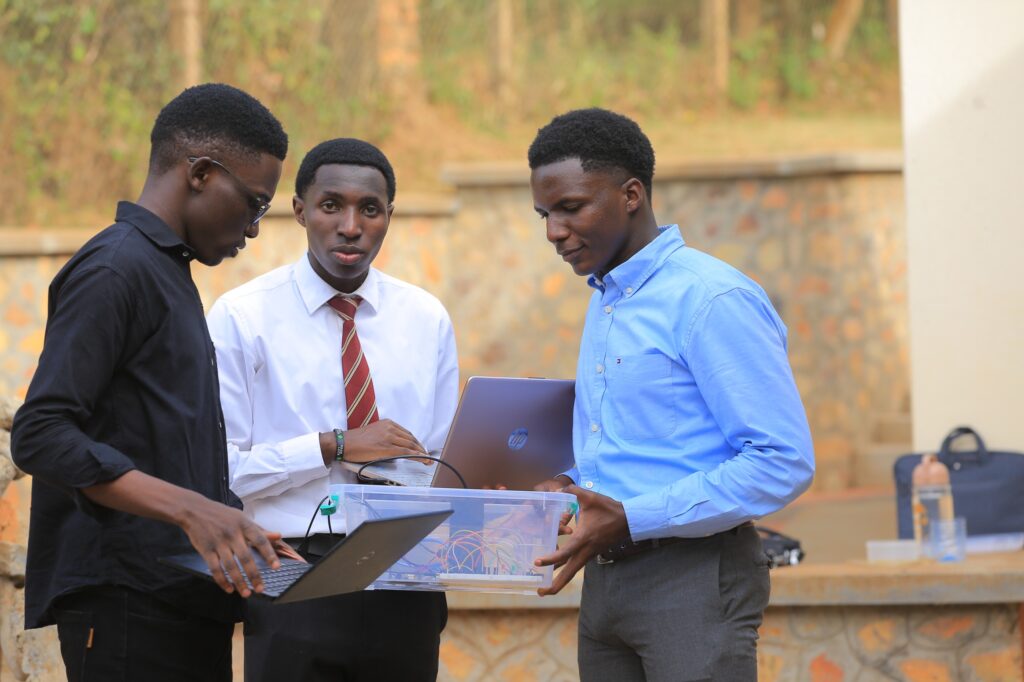
For Dickson, the solution is a way to end the guesswork that often leads farmers to either over-irrigate or under-irrigate their crops a challenge made worse by the prolonged drought Uganda has experienced since October.
In the health category, a team made up of Natabo Dorcus Kwagala, Musiimenta Daphineliz, and Ninsiima Whitney introduced a Cervical Cancer Diet Guide App aimed at patients who struggle to access nutritionists. “Patients often go home without receiving nutritional guidance. We wanted to bridge that gap,” Dorcus said.
The app generates personalised meal plans based on a patient’s age, BMI, and cancer stag,e a potentially vital intervention in a country that records more than 6,000 new cervical cancer cases each year, many of which are worsened by poor nutritional support.
Another group, Emelda Nakacwa, Robert Ssekisonge, and Joseph Okolimo, turned their attention to the recurrent issue of examination leaks in higher education.
Their Unified Examination Management System (UEMS) digitises the exam-setting and moderation process, replacing the current paper-based approach that is prone to manipulation.“The traditional system is vulnerable. Our goal was to remove the weak points,” Emelda said.
The platform incorporates security features such as screenshot blocking, disabled computer functions, and mandatory camera monitoring. “We wanted a system that builds trust for both students and lecturers,” Okolimo added.
The conversation then shifted to urban management, where Rubagumya Alvin, Agaba Itungo, and Oba Mark Calvin presented an IoT-enabled smart waste predictive routing system. Designed with Kampala’s chronic waste crisis in mind, the system uses sensor-equipped bins that alert collectors when nearly full, while software recommends the most efficient collection routes.
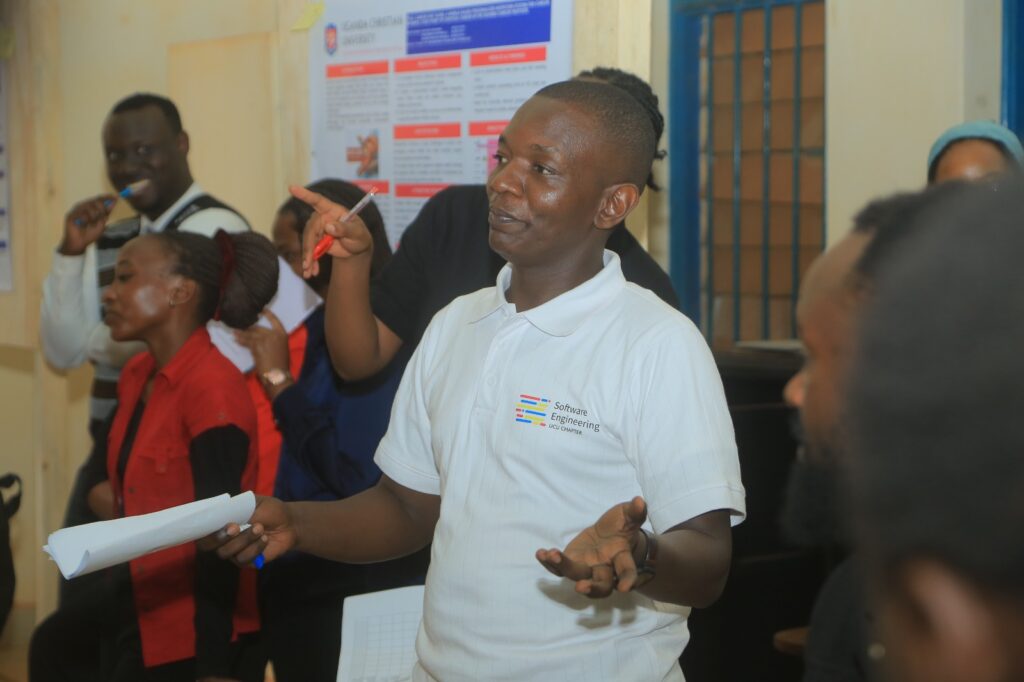
“Overflowing bins are a daily sight in parts of the city,” Alvin noted. The team said KCCA officials had expressed interest in exploring the prototype further. “They told us the city needs something that actually works on the ground. That’s what we are trying to build,” Agaba said.
The final project of the day, VOX-AID, was created by Laker Joanna Otim, Laker Jessy Okeelowange, Atwine Vivian, and Khaukha Ronald. The assistive device is designed for non-verbal cerebral palsy patients, using heartbeat patterns and sound inputs to interpret a patient’s emotional state.
Non-verbal patients often struggle to express how they feel. We wanted to give those emotions a voice,” Joanna said. Khaukha added that the device could help caregivers respond more quickly and appropriately to distress.
Closing the showcase, Dr Ndibatya praised the students for their creativity and maturity. “What you have done today shows that technology can be a real solution to our communities’ problems,” he said.
Compiled by: By Andrew Bugembe